
Loading Dock Paving Hunterdon County NJ

Built for Heavy Loads, Not Constant Repairs

Your loading dock takes more punishment in a week than most parking lots see in a year. Trailer jacks, forklifts, and 80,000-pound trucks demand industrial-grade asphalt paving that won’t crack, rut, or fail when operations depend on it.

Family Expertise Since 1948

Seventy-five years of proven asphalt knowledge means we understand what heavy-duty surfaces actually need to perform under industrial conditions.

One Crew One Job

Your loading dock gets our full attention from start to finish. No juggling multiple sites, no rushing to the next job.

Owner on Every Project

Direct oversight and accountability on your jobsite. You work with the people who own the outcome, not a subcontractor.

Transparent Project Communication

Clear updates throughout your project. You know what's happening, when it's happening, and why it matters for your operation.

Industrial Loading Dock Paving Services

Pavement That Handles What Standard Asphalt Can't

Loading dock paving isn’t the same as a parking lot. The surface has to handle stationary trailer jacks that concentrate tens of thousands of pounds into a few square inches. It needs to resist rutting when forklifts make tight turns under load. And it can’t fail when a missed delivery costs you thousands in downtime. Standard asphalt wasn’t designed for this. Loading dock surfaces require heavier base preparation, thicker asphalt layers, and mix designs that resist deformation under constant stress. In many cases, concrete landing strips become necessary where trailer landing gear sits, preventing the asphalt from depressing in summer heat. The difference between a loading dock that lasts twenty years and one that fails in five comes down to understanding these demands before the first truck rolls across it.

Heavy-Duty Asphalt Paving Benefits

What Proper Loading Dock Paving Actually Does

Beyond keeping trucks level with your dock, the right surface protects your operation from disruptions you can’t afford.

Your shipping schedule stays on track because the pavement doesn't crack or settle under daily trailer traffic.

Forklift operators move safely across smooth, level surfaces without dodging potholes or uneven joints.

Trailer jacks sit stable without sinking into softened asphalt, even during the hottest summer days.

Water drains away from the dock face instead of pooling and undermining your base during freeze-thaw cycles.

You avoid emergency repairs that shut down bays and reroute deliveries while crews patch failing pavement.

The surface holds up for decades with basic maintenance instead of needing replacement every few years.

Ready to get started?

Share project details

Call us or get a free online quote to help us identify your project needs.

We'll follow up

If you requested an online quote, you can expect a callback within 24-48 hours of your request.

The floor is yours

Connect with an expert and share all project specifics.

Plan your project

Like what you hear? We'll provide next steps and expert guidance.
Warehouse Paving Contractor Experience

Why Loading Docks Destroy Standard Asphalt

A single 80,000-pound truck causes as much pavement wear as 9,600 cars. When that truck parks at your dock with its weight concentrated on landing gear, the stress multiplies. Standard residential-grade asphalt—designed for cars making rolling passes—can’t handle this. The asphalt softens. Trailer jacks sink. Cracks form around the depression. Water seeps in. The base weakens. Within a season, you’re patching. Within two, you’re replacing sections. The cycle repeats because the pavement was never built for the load. Loading dock paving starts with understanding these forces. Thicker asphalt layers spread the load. Stronger aggregate mixes resist deformation. Proper base preparation provides stable support. In areas where trailers park regularly, concrete pads handle the concentrated point loads that asphalt can’t. This isn’t about using more material. It’s about using the right material in the right configuration for what actually happens at your dock.

Freight Terminal Paving Solutions

What Goes Into Industrial-Grade Loading Dock Surfaces

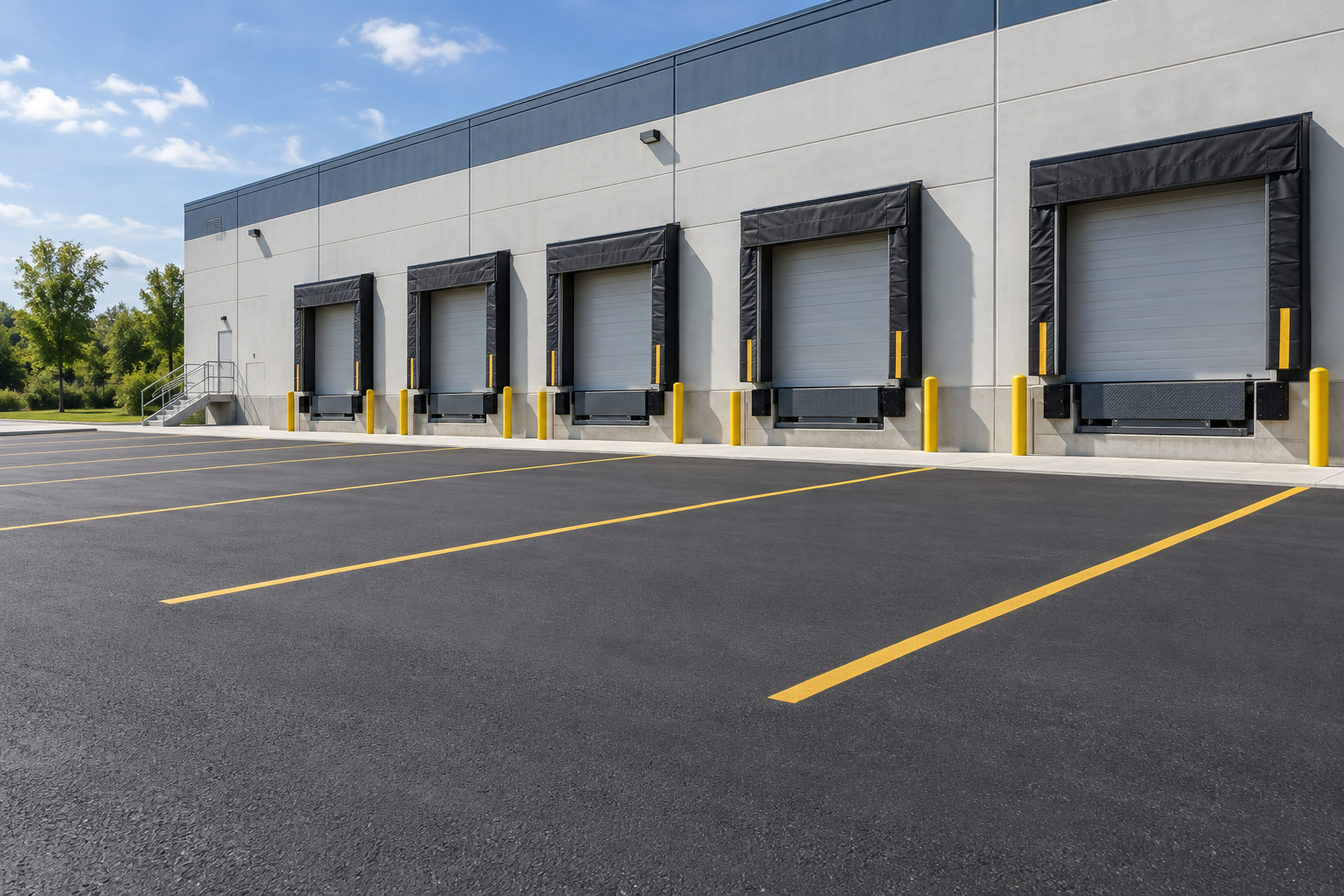
Heavy-duty loading dock paving typically requires seven to nine inches of total pavement thickness for areas handling constant truck traffic. The base layer uses larger aggregate—three-quarters to one-and-a-half inches—to create stronger interlock and better load distribution. Drainage design prevents the base failure that kills most loading docks. Water that sits under pavement softens the subgrade. When trucks roll over softened ground, the surface breaks down. Proper grading, catch basins, and subsurface drainage keep water moving away from high-stress areas. For zones where trailers park with landing gear down, concrete landing strips prevent the rutting that happens when asphalt heats up. These strips handle the concentrated loads without deforming, protecting the surrounding asphalt from stress cracks. The approach area—where trucks approach and align with the dock—needs attention too. Tight turning radiuses under load create shear forces that standard mixes can’t resist. The right surface prevents the shoving and rutting that develops at these transition points.
Fresh black asphalt being laid by paving machinery

Site Assessment and Design

We evaluate your truck traffic patterns, load concentrations, and drainage conditions to design pavement that matches your actual operational demands.

Base Preparation and Grading

Proper subgrade compaction and drainage installation create the stable foundation that prevents the base failure most loading docks eventually face.

Heavy-Duty Paving Installation

We install industrial-grade asphalt in the proper thickness with concrete landing strips where needed, working around your schedule to minimize disruption.