Asphalt vs Concrete: Material Guide for Homeowners
You’re comparing asphalt and concrete because you know this decision matters. Your driveway isn’t just a place to park—it’s a long-term investment that needs to hold up through New Jersey winters, look decent, and not drain your bank account in five years. The problem is every contractor has a different opinion, and half the information online contradicts the other half. This guide cuts through the noise. You’ll understand what each material actually costs upfront and over time, how they perform in real conditions, and what maintenance looks like when you’re the one doing it. No fluff, no agenda—just the information you need to make a decision you’ll feel good about years from now.
What’s the Real Difference Between Asphalt and Concrete Driveways
Asphalt and concrete start with similar ingredients—stone, sand, and aggregate—but use different binders that change everything about how they perform. Asphalt uses petroleum-based bitumen as its binder, creating a flexible, dark surface. Concrete mixes cement with water as its binder, resulting in a rigid, lighter-colored surface.
That difference in flexibility matters more than you’d think. Asphalt bends slightly when temperatures shift or the ground moves, which is why it handles freeze-thaw cycles better. Concrete stays rigid, which gives it strength but makes it more prone to cracking when conditions change. Neither approach is inherently better—they’re just built for different priorities.
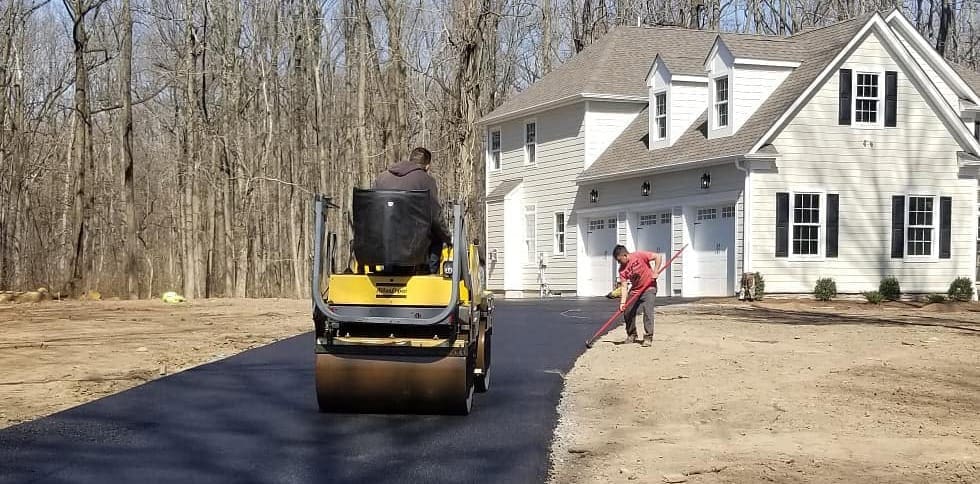
The installation process differs too. Asphalt gets heated, poured, rolled, and compacted, then it’s ready to use within a day or two. Concrete gets poured into forms and needs seven days minimum to cure before you can drive on it. If you need your driveway back fast, that timing difference isn’t trivial.
Is Asphalt Cheaper Than Concrete
Yes, asphalt costs less upfront—usually 30 to 45 percent less than concrete. You’re looking at $7 to $15 per square foot for asphalt versus $8 to $20 per square foot for concrete. For a typical two-car driveway around 600 square feet, that’s a difference of $1,200 to $3,000 right at installation.
But upfront cost tells only part of the story. Asphalt needs sealcoating every three to five years, which runs $300 to $800 each time depending on your driveway size. Over 20 years, you’re adding $1,200 to $3,200 in maintenance costs. Concrete needs sealing less frequently—every five to ten years if you seal it at all—but when repairs are needed, they cost more.
The total cost picture depends on how long you plan to stay in your home. If you’re looking at 10 to 15 years, asphalt usually stays cheaper overall. Beyond 20 years, the costs start to even out, and concrete’s longer lifespan begins to show its value. Neither option is a clear winner financially—it depends on your timeline and how you value your time spent on maintenance.
Here’s what most cost comparisons miss: asphalt repairs are easier and cheaper when something goes wrong. Cracks and potholes can be patched for $100 to $300 in most cases. Concrete repairs often require professional help and can run $300 to $3,000 depending on the damage. That difference in repair costs matters if you’re the type who’d rather handle small fixes yourself or if your property has conditions that stress your driveway.
The installation speed also has a hidden cost factor. Asphalt is driveable in 24 to 48 hours. Concrete needs seven days to cure. If you can’t park on the street for a week or need to coordinate around your schedule, that downtime has a real cost even if it’s not written on the invoice.
Cost of Asphalt vs Concrete Over Time
Looking at 20-year total ownership costs gives you a more honest picture than installation price alone. A 600-square-foot asphalt driveway might cost $5,400 to install. Add sealcoating every four years at $500 each time, and you’re at $8,400 total over 20 years. That same driveway in concrete might cost $7,800 to install, plus two sealant applications at $400 each, bringing you to $8,600 over 20 years.
The numbers get closer than most people expect. But that calculation assumes normal conditions and regular maintenance. If you skip maintenance on asphalt, it deteriorates faster and might need resurfacing or replacement before 20 years. If you skip maintenance on concrete, it lasts longer before showing problems, but when issues appear, they’re more expensive to fix.
Your property conditions matter too. If you have heavy clay soil that shifts with moisture changes, asphalt’s flexibility helps it adapt without cracking. That could save you repair costs that concrete would rack up in the same conditions. If you park heavy vehicles regularly, concrete’s strength means less wear and fewer repairs over time.
Climate plays a bigger role in long-term costs than most homeowners realize. In New Jersey, freeze-thaw cycles are your driveway’s biggest enemy. Water seeps into small cracks, freezes, expands, and makes those cracks bigger. Asphalt’s flexibility helps it survive these cycles with less damage. Concrete’s rigidity means cracks tend to worsen faster when freeze-thaw cycles hit.
The maintenance schedule matters too, but not just for costs. Asphalt maintenance is more frequent but simpler—you can handle some tasks yourself if you’re inclined. Concrete maintenance is less frequent but often requires professional help when needed. Factor in your own time and willingness to stay on top of maintenance when calculating real costs.
One cost factor nobody talks about: resale value. A well-maintained driveway of either material adds value to your home. A neglected driveway of either material detracts from it. The material matters less than the condition when you’re selling. Keep that in mind if you’re choosing based on which is “better” for resale.
Concrete or Asphalt Driveway: Which Lasts Longer in New Jersey
Concrete typically lasts 30 to 40 years with proper maintenance, sometimes pushing 50 years in ideal conditions. Asphalt generally lasts 15 to 30 years with regular care. Those numbers sound definitive, but New Jersey’s climate changes the equation.
New Jersey gives you the worst of both worlds weatherwise—brutal winters with freeze-thaw cycles and hot, humid summers. Asphalt handles the winter side better because it flexes with temperature changes instead of cracking. Concrete handles the summer side better because it doesn’t soften in heat the way asphalt can.
The “lasts longer” question really depends on which weather extreme your property faces more. If your driveway gets full sun exposure in summer, asphalt might soften slightly during heat waves, creating minor ruts over time. If your driveway stays shaded and holds moisture, concrete might crack more from freeze-thaw cycles. Neither scenario is a deal-breaker, but it shifts which material actually lasts longer in your specific situation.
How New Jersey Weather Affects Driveway Materials
Freeze-thaw cycles are the real test for driveway materials in New Jersey. Water gets into small cracks, freezes overnight, expands by about nine percent, and pushes the crack wider. Then it thaws, more water gets in, and the cycle repeats. Over one winter, you might see 30 to 50 freeze-thaw cycles depending on where you are in the state.
Asphalt’s flexibility lets it absorb some of this expansion and contraction without catastrophic cracking. The material bends slightly, releases stress, and returns to form. That’s why you see asphalt driveways in northern climates lasting 20-plus years even with harsh winters. The petroleum-based binder stays somewhat pliable even in cold temperatures.
Concrete’s rigidity means it can’t flex with these temperature swings. Once a crack starts, freeze-thaw cycles make it worse quickly. You might start with a hairline crack in November and have a quarter-inch crack by March. That’s not a failure of concrete as a material—it’s just how rigid materials respond to expansion and contraction forces.
Summer heat affects both materials but in different ways. Asphalt can soften when temperatures hit 90 degrees and above for extended periods. You might notice slight tire marks or a tacky feel on extremely hot days. It re-hardens when temperatures drop, so it’s not permanent damage, but repeated softening over years can contribute to surface wear and minor deformation.
Concrete stays stable in heat, which is an advantage. It doesn’t soften, doesn’t become tacky, and doesn’t develop heat-related surface issues. The light color also reflects heat rather than absorbing it, which keeps the surface cooler to walk on. That matters if you have kids or pets using the driveway in summer.
Moisture management becomes critical in New Jersey’s humid climate. Both materials need proper drainage to prevent water from pooling and penetrating the surface. Standing water accelerates deterioration for both asphalt and concrete. The difference is that asphalt damage from water tends to show up as gradual surface degradation, while concrete damage shows up as cracks that spread.
De-icing salt is another New Jersey reality. Salt accelerates concrete surface deterioration, causing scaling and pitting over time. Asphalt resists salt damage better, though salt can still contribute to edge deterioration if you’re heavy-handed with application. If you use a lot of de-icer every winter, that tips the durability equation slightly toward asphalt.
Maintenance Requirements: What You’re Actually Signing Up For
Asphalt maintenance isn’t complicated, but it is regular. You’ll need to sealcoat within the first year after installation, then every three to five years after that. Sealcoating takes a day, costs $300 to $800 for a typical driveway, and protects the surface from UV damage, water penetration, and oxidation. Skip it, and your asphalt ages faster—fading from black to gray, becoming brittle, and developing cracks sooner.
Between sealcoating cycles, you’ll want to fill cracks as they appear. Small cracks are easy—you can buy crack filler at any hardware store and handle it yourself in an afternoon. Let those small cracks go, and they become bigger cracks, then potholes, then you’re looking at more expensive repairs. Staying on top of minor maintenance prevents major repairs. For example, a hairline crack you fill in April for $15 in materials won’t become the $400 pothole repair you’re facing by November.
Concrete maintenance is less frequent but less forgiving when you skip it. Sealing concrete every five to ten years helps protect against water penetration and staining, but many homeowners skip sealing entirely and still get decades of life from their concrete. The trade-off is that unsealed concrete is more susceptible to staining from oil, rust, and other substances.
Cleaning matters more for concrete than asphalt. Concrete’s lighter color shows every oil drip, tire mark, and stain. You’ll want to pressure wash annually and deal with stains promptly. Asphalt hides stains better thanks to its dark color, though it still benefits from occasional cleaning to remove debris and prevent organic growth in shaded areas.
Crack repair on concrete is trickier. Small cracks can be filled with concrete patch compound, but getting the patch to blend with the existing surface is difficult. Larger cracks often require professional repair, and even then, the patch is usually visible. That’s not a structural issue, but it affects appearance. Asphalt patches blend better, which makes DIY repairs more viable.
The real maintenance difference comes down to frequency versus difficulty. Asphalt asks for attention more often but gives you tasks you can handle yourself. Concrete asks for attention less often but often requires professional help when problems arise. Which approach fits your situation better depends on whether you’d rather stay on top of regular small tasks or deal with occasional larger interventions.
One maintenance factor that’s easy to overlook: edge support. Both materials benefit from proper edge support to prevent crumbling and deterioration along the sides. Asphalt edges are more vulnerable to crumbling, especially if you drive over them regularly. Concrete edges are more stable but can still chip if not properly supported. Neither material loves being undermined by erosion or plant growth along the edges.
Making the Right Material Choice for Your Property
There’s no universal “better” choice between asphalt and concrete—just the choice that fits your property, budget, and priorities. Asphalt costs less upfront, handles New Jersey’s freeze-thaw cycles better, and offers easier repairs. Concrete lasts longer, requires less frequent maintenance, and gives you more design options. Both materials perform well when installed correctly and maintained properly.
Your decision comes down to a few key questions. How long do you plan to stay in your home? What’s your budget for upfront costs versus ongoing maintenance? Are you comfortable handling regular small maintenance tasks, or would you rather minimize intervention? How does your property’s sun exposure, drainage, and soil conditions affect material performance?
If you’re still weighing your options and want guidance based on your specific property conditions, we bring 75 years of family paving experience and over 30,000 completed jobs to help you understand which material makes sense for your situation. We’ve installed both asphalt and concrete throughout Hunterdon County since 1948 and can walk you through what actually works in local conditions—not what sounds good in theory.