What Residential Paving Homeowners Should Know
You’re standing in your driveway looking at cracks that weren’t there last year. Or maybe you’re building new and trying to figure out if you should go with asphalt, concrete, or something else entirely. Either way, you’re about to spend thousands of dollars on something that’ll be front and center at your property for the next two or three decades.
The problem is that most homeowners don’t know what separates a quality residential paving job from one that’ll need replacing in five years. You don’t know which questions to ask contractors or what red flags to watch for. That uncertainty makes it easy to choose based on price alone and hope for the best.
This guide changes that. You’ll learn what actually matters when it comes to residential paving, what the process should look like, and how to spot the difference between a contractor who knows what they’re doing and one who’s cutting corners.
Understanding Residential Paving Options and Materials
Residential paving comes down to three main options: asphalt, concrete, and pavers. Each has trade-offs that matter depending on your climate, budget, and how long you plan to stay in your home.
Asphalt typically costs $3.50-$6 per square foot installed in New Jersey as of 2026, making it 30-40% less expensive than concrete. That’s a meaningful difference when you’re paving a 600-square-foot driveway. If you live in a cold, snowy climate like Hunterdon County, asphalt is the better choice because it flexes with freeze-thaw cycles rather than cracking like concrete does in hot climates.
Concrete runs higher at $7-$12 per square foot but can last 30-40 years compared to asphalt’s 15-30 year lifespan. The problem is that concrete tends to crack and heave in freezing temperatures common to northern New Jersey winters, and repairs are difficult with high costs. Salt used for ice melting can also create pits in concrete, leaving blotches across the surface.
Why Asphalt Works Better for New Jersey Driveways
New Jersey’s climate puts driveways through hell. You’ve got summer heat that can hit 95 degrees, winter cold that drops below freezing for weeks, and the constant freeze-thaw cycle that destroys rigid materials.
Asphalt can bend and flex above 40 degrees, allowing it to withstand significant subsurface movement and create a durable surface that can last up to twenty years. That flexibility is what keeps it from cracking when the ground beneath it shifts during freeze-thaw cycles. Concrete doesn’t have that advantage. It’s rigid, so when the ground moves, the concrete cracks.
Asphalt is extremely flexible, allowing it to move with natural settlements of the earth. It holds up better than other alternatives in the New Jersey climate and is resistant to thawing and freezing, so you don’t need to salt the driveway in the cold. That last point matters more than most people realize. Every time you salt a concrete driveway, you’re accelerating its deterioration.
The other advantage is repair. When asphalt develops a crack or pothole, you can patch it and the repair blends in. Asphalt surfaces can be repaired and blended much easier than concrete. With concrete, patches are obvious and often don’t match the original pour. If a large section fails, you’re looking at replacing entire slabs.
Cost is the other factor. Asphalt paving typically runs about $3.00 to $4.00 per square foot depending on the scope of the project, including property quality, topography, slopes, and curves. For a standard two-car driveway, that difference between asphalt and concrete can mean $2,000 to $4,000 in your pocket. That’s real money, especially when asphalt is actually better suited to the climate.
The maintenance requirements are different too. Asphalt driveways should be treated within 6 months to one year after installation, then every other year or two depending on traffic. This will beautify your property and protect against elements like water, chemicals, salt and oil. Yes, that’s an ongoing cost, but it’s manageable and extends the life of your driveway significantly. Concrete requires less frequent sealing but when major repairs are needed, they’re expensive and disruptive.
What Actually Determines Asphalt Driveway Costs
You’ll get quotes that range from $3 to $7 per square foot, and the variation isn’t random. Understanding what drives those differences helps you evaluate whether you’re getting a fair price or being overcharged for standard work.
The biggest cost factors include size of the project (larger areas have lower per-square-foot costs), site preparation needs (excavation, grading, base work), thickness requirements, accessibility, local material prices and availability, drainage requirements, and removal of existing pavement if needed. Size matters because contractors can work more efficiently on larger projects. A 300-square-foot driveway costs more per square foot than a 1,000-square-foot one because setup time and equipment costs are the same regardless of size.
Site preparation is where contractors either do the job right or cut corners to save money. A standard residential driveway is typically 2-3 inches thick with proper base support, and you should expect a minimum compacted thickness of 2 to 3 inches for residential driveways. Anything less is a shortcut that’ll cost you later. The base beneath that asphalt matters even more. If your soil is clay-based, you should install about 8 inches of crushed rock. If the soil is sandy, you’ll need at least 4 inches of crushed rock.
Accessibility affects cost too. If your driveway is easy to reach with trucks and equipment, costs stay lower. If crews have to work around obstacles, navigate tight spaces, or haul materials long distances from the street, expect to pay more. That’s legitimate added labor, not padding.
Drainage is a factor that will extend the life of your driveway. If your driveway slopes toward your house, French drains can be installed to divert water. Some communities have requirements about handling water from your property. Local material costs such as fuel, material and freight can fluctuate, leading to higher or lower prices. Fuel prices directly impact asphalt costs since it’s a petroleum-based product. When oil prices spike, asphalt costs follow.
Removal of existing pavement adds $1-$3 per square foot to your project. Some contractors include this in their base quote, others list it separately. Make sure you’re comparing apples to apples when you look at estimates. A quote that seems high might actually include removal, grading, and drainage work that a lower quote doesn’t mention at all.
The time of year matters too. Install your asphalt driveway in the spring or summer to provide warm enough conditions for hot mix asphalt paving. Contractors are busier during peak season, which can drive prices up slightly, but the quality of installation is better when weather conditions are ideal. Trying to save money by scheduling work in late fall or early spring can backfire if temperatures drop and the asphalt doesn’t cure properly.
Residential Driveway Paving Process and Installation
A proper residential driveway installation follows specific steps that can’t be skipped without compromising the final result. Understanding this process helps you recognize when a contractor is doing quality work versus when they’re rushing through to get to the next job.
The first step is to remove the existing surface, whether it’s asphalt, concrete or pavers, using heavy machinery including small bobcats, forklifts, and when necessary, front loaders and large dump trucks. Debris is then removed. We recycle old asphalt rather than dumping it, which is both environmentally responsible and often saves on material costs.
With a clean slate, technology helps prepare the surface for appropriate water drainage. Using laser-guided transits and automatic motor graders, we grade the surface to ensure water will run off appropriately. This step is critical. Water is the enemy of any paved surface, and proper grading is your first line of defense.
Base Preparation and Why It Matters More Than You Think
Most homeowners focus on the surface they can see. That’s a mistake. The base beneath your asphalt determines whether your driveway lasts 10 years or 30.
Creating a stable yet adaptive sub-base is the most important step in asphalt installation. Most asphalt cracks result from a sub-base that was insufficiently built or was eroded or damaged over time. A proper base does two things: it provides stable support for the weight of vehicles, and it manages water so it doesn’t accumulate beneath the asphalt where it can cause heaving and cracking.
The baserock is installed next, composed of aggregate rock material which provides a stable surface to support the new asphalt. It also provides a frost barrier, which reduces freeze/thaw damage in cold climates. In New Jersey, that frost barrier is essential. Without it, moisture in the soil freezes, expands, and pushes up on the asphalt from below. When it thaws, the asphalt settles unevenly. Repeat that cycle a few dozen times and you’ve got cracks and depressions.
The aggregate base needs to be compacted properly. As the aggregate base is installed, you’ll need to make sure the rock is distributed evenly and that it’s compacted with a roller to ensure stability. Contractors who skip proper compaction or don’t use the right equipment are setting you up for failure. The base will settle unevenly under the weight of vehicles, causing the asphalt surface to crack and develop low spots where water pools.
The sub-base should be 8 inches of crushed stone that has been fractured so it has angular edges that interlock under compression. The best option is aggregate base course, also known as crusher run, a mix of stone of every size from about 3/8 inch down to stone dust, so it knits together extremely well. The angular edges are what create that interlocking effect. Round gravel doesn’t work the same way because the stones slide past each other instead of locking together.
After the base is in place, contractors perform what’s called a proof roll. Once this step is done, it’s time for a proof roll, which is a test to be sure the underlying surface is strong enough to support the new asphalt. This involves driving heavy equipment over the compacted base to identify any soft spots or areas that need additional work. Contractors who skip this step are gambling with your money.
Water management gets built into the base layer too. Drainage is a factor that will extend the life of your driveway or private road. If your driveway slopes toward your house, French drains can be installed to divert the water. Some properties need more elaborate drainage solutions, others just need proper grading. A good contractor assesses your specific situation and recommends what’s actually needed, not what’s most profitable.
Asphalt Installation and What to Expect During the Process
Once the base is ready, the actual asphalt installation happens relatively quickly. But there are still details that separate quality work from a rushed job.
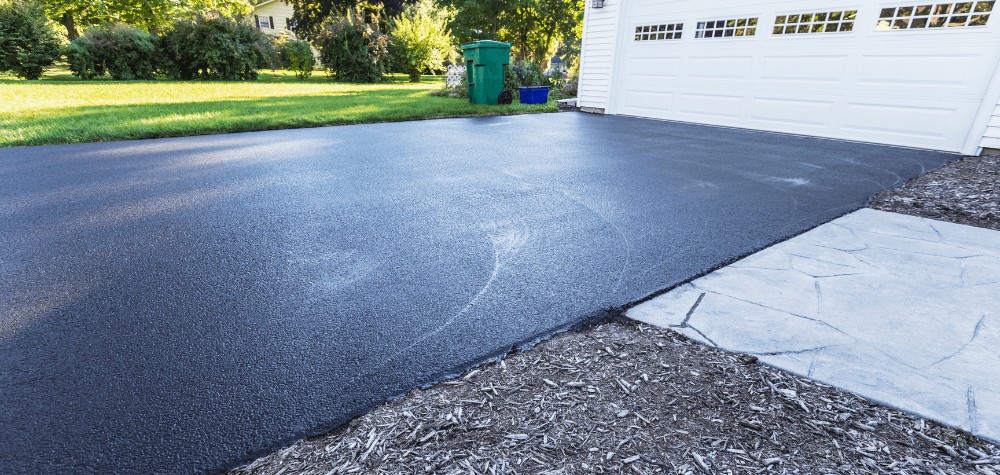
Surface asphalt is made up of sand, oil, and small aggregate. The combination of these three materials creates that jet-black asphalt look and when installed correctly provides a smooth, shiny and attractive finish. The asphalt arrives hot from the plant, typically above 300 degrees Fahrenheit, and needs to be placed and compacted while it’s still hot enough to be workable.
For residential jobs, contractors typically use hot mix asphalt designed for lighter loads but still offering durability and flexibility. The mix should be matched to the specific use of your driveway, not borrowed from a commercial road spec or patched in from leftovers. Some contractors try to save money by using whatever mix they have left over from another job. That’s a problem because different mixes have different properties. What works for a heavy-traffic commercial lot isn’t necessarily right for a residential driveway.
Ideal asphalt work happens when temperatures are warm enough for proper compaction and bonding. Moisture also plays a huge role. A dry base is essential for the asphalt to cure correctly and set into a solid, long-lasting surface. This is why spring and summer installations produce better results. The asphalt bonds properly to the base, compacts evenly, and cures without the complications that come with cold or damp conditions.
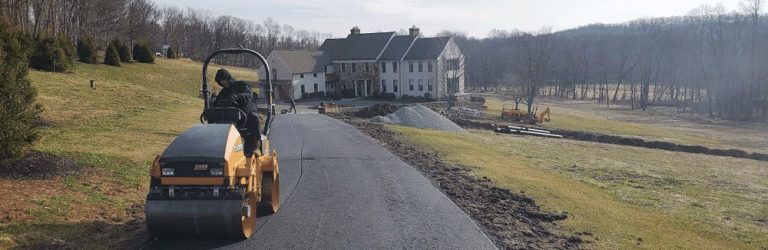
Using a roller truck, the new asphalt pavement surface is compacted and smoothed. This process ensures that no small bumps of aggregate or stone are left poking through the smooth new surface. Proper compaction is what gives asphalt its strength. Under-compacted asphalt is more porous, which means water can penetrate more easily. It’s also less dense, so it wears faster under traffic.
If your new driveway connects to an existing surface like your garage apron or the street, contractors need to create smooth transitions. Butt joints is the official name of the areas where old asphalt meets new asphalt. More than aesthetically pleasing, butt joints need to be graded correctly to make sure water will run off at every butt joint and you don’t end up with damaged patches. Poor transitions create lips where water accumulates and where snow plows can catch and damage the edge of your new driveway.
Paving your driveway will take 3 hours, after which you won’t be able to drive on the surface for 3 days. That timeline is important. Keep all vehicle traffic off of it for at least 3 days, 5 days if outside temperatures are above 80 degrees. It’s best to wait up to 14 days to park on your new driveway. Fresh asphalt usually takes 6-12 months to harden and cure. Driving on asphalt before it’s ready can leave permanent depressions and damage the surface before you’ve even had a chance to enjoy it.
Making the Right Choice for Your Residential Paving Project
Residential paving is one of those projects where doing it right the first time costs less than doing it twice. You now understand what separates quality work from shortcuts, what questions to ask contractors, and what to expect during installation and beyond.
The key takeaways: asphalt works better than concrete in New Jersey’s climate, proper base preparation matters more than surface thickness, water management determines longevity, and the contractor you choose makes all the difference. Don’t choose based on price alone. Choose based on experience, process, and whether the contractor treats your project like it matters.
If you’re in Hunterdon County and ready to move forward with residential paving that’s done right, we’ve been serving local homeowners with the same attention to detail and quality workmanship since 1948. Every project gets the full attention it deserves, with custom solutions designed for your property’s specific needs.